
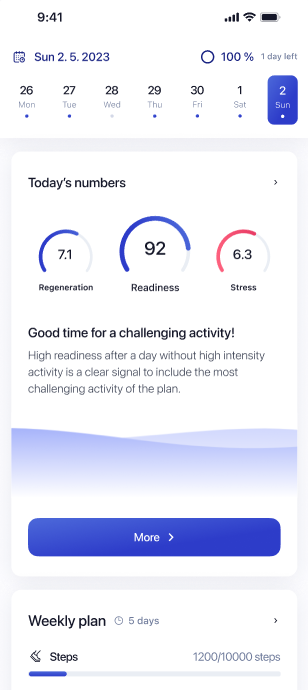
Below is an overview of the three main metrics that Elonga evaluates based on your morning HRV measurement. These metrics help you better understand your current physiological state and plan your daily routine and physical load more effectively.
Readiness
Readiness (0–100) shows the current state of your body and indicates how well prepared it is for the day whether for physical activity, work performance, or mental stress.
This value helps determine the optimal level of load your body can handle safely and efficiently, without risking overtraining or exhaustion.
It also allows you to make the most of your available capacity.
Stress
The Stress indicator reflects the activity of the sympathetic nervous system, responsible for activation, performance, and the physiological stress response.
displayed on a 0–10 scale
results are compared to your peers (same age and gender)
after 5 consecutive measurements, your personal color-coded scale will appear
Stress can be influenced by many factors:
sleep
physical activity
mental load
nutrition
illness
other lifestyle or physiological factors
Long-term tracking helps reveal what increases your stress the most and what helps reduce it.
Recovery
The Recovery metric reflects the activity of the parasympathetic nervous system, which supports energy restoration, effective recovery, and returning the body to a relaxed state.
displayed on a 0–10 scale
results are compared to your peers (same age and gender)
after 5 consecutive measurements, your personal color-coded scale will appear
This indicator helps you understand how quickly and effectively your body is recovering and whether it is ready for additional physical or mental load.
Was this article helpful?
That’s Great!
Thank you for your feedback
Sorry! We couldn't be helpful
Thank you for your feedback
Feedback sent
We appreciate your effort and will try to fix the article